By Catherine Thurston, LCSW
Published in Behavioral Health News (August 2026)
Policy-making can solve systemic problems, but we can only achieve true behavioral healthcare reform with adequate financial resources. Advocating for public support for mental healthcare takes time, persistence, and a group effort.
One of the most successful examples of collaboration in New York State was the Geriatric Mental Health Alliance, a 3,000-member coalition formed over 20 years ago, which successfully advocated for the passage of the 2005 New York State Geriatric Mental Health Act. This act established an evergreen interagency planning council and, most importantly, ensured that the New York State Office of Mental Health (OMH) was empowered to fund innovative programs to support older adults living with serious mental health conditions.
OMH has completed five rounds of Geriatric Service Demonstration grants to agencies throughout New York State, providing much-needed financial support for integrated mental health treatment, physical health care, substance use treatment, and services to support aging in place. Service Program for Older People (SPOP) is a proud grant recipient, and we celebrate the incredible gains that older adults have made as a result of innovative programming supported by OMH.
SPOP is a community-based behavioral health provider for older adults (55+) based in New York City. We serve 1,000 clients annually through an outpatient clinic and a psychiatric rehabilitation day program (PROS) for adults with serious mental illness. We offer a full range of services including individual and group therapy, psychiatry, medication management, assessments, bereavement support, group-based psychiatric rehabilitation services, creative arts therapies, social healthcare, and linkages to support for housing, meals, and financial assistance.
With the support of a 2021 OMH geriatric service demonstration grant, SPOP developed and launched a social health program for older adults living with unmet needs in mental health, substance use and aging. The project represented a major expansion of SPOP’s scope of service and enabled us to provide direct support to address housing and food insecurity, social isolation, transportation, and substance misuse. This assistance is provided in coordination with mental healthcare, with a goal to stabilize clients and teach them coping and independent living skills.
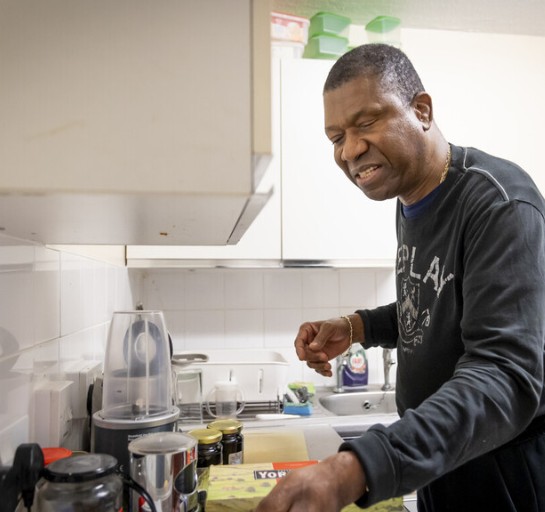
“Fred,” age 72, worked more than 40 years before he was laid off in 2020. Without steady income, his life started to unravel. He was in recovery from opioid addiction and he founding himself struggling with drug cravings and loneliness. He worried constantly about money, often ignored his mail, and fell behind in his rent. His landlord threatened eviction at the same time that Fred learned that his entitlements had been terminated because he had overlooked notices sent by mail. He was overwhelmed with anxiety and fear of becoming unhoused, and when his symptoms became so severe that he could not sit still in a chair, he sought help at SPOP.
SPOP’s initial work with Fred focused on stabilizing his mental health symptoms, using the team approach funded by the geriatric service demonstration grant. We connected him to the Recovery Program at Metropolitan Center for Mental Health, where he attended groups and received renewed psychiatric support. He also met with a SPOP therapist and with certified peer specialists, whose lived experience with mental health and substance use recovery planted the seeds of hope with Fred.
A social work intern at SPOP helped Fred set up his first email account, taught him how to use a smart phone, and encouraged him to join an older adult center where he had access to meals and social activities. We also coached him in how to access the portal to his HRA account, gave him a $50 supermarket gift card for food purchases, and helped him buy a pair of winter boots. He commented that “You just don’t feel like a real human if you can’t walk around the city — especially if you can’t walk around with a little money in your pocket to get a meal.”
Fred now has stable housing and is engaged in ongoing therapy and substance use treatment. His HRA account is active and he never misses a notification. He is on the road to a sustainable and healthier life. And his boots keep him on the ground.
Fred’s story began more than two decades ago when some 3,000 providers in the fields of aging and mental healthcare banded together to call attention to the urgent need for sustained funding to support older adults in New York State The passage of the Geriatric Mental Health Act of 2005 – together with adequate funding and deliberate leadership and stewardship – has improved the lives of thousands of individuals like Fred.